Jan 092008
 

From the WSJ:

Why Donating Millions Is Hard To Keep Secret
Anonymous Gifts Are Growing, But Groups Are Under Pressure To Reveal Benefactors’ Names
By SALLY BEATTY

…publicity-shy donors say they want to give back to their communities but avoid the headaches of a high public profile, including pushy fund-raisers, jealous relatives and even risks to their personal safety.

…Proponents of greater disclosure by charities, including some lawmakers and consumer groups, argue that keeping givers’ identities secret can mask efforts by wealthy individuals and corporations to use philanthropy as a tool of undue influence.

To say nothing of philanthropists getting tax breaks to fund programs that support the governing class in having its way with less wealthy taxpayers.

…And political rivals of presidential candidate Sen. Hillary Clinton have pressed her husband, former president Bill Clinton, to reveal names of anonymous donors to his foundation.

Sounds like a great way for the Clintons to subvert campaign finance regulation.

…Wealthy donors have different reasons for wanting to stay out of the limelight. Most major religions, including Christianity, Judaism and Islam, regard anonymous gifts as a more sincere or even higher form of giving compared with gifts for which the donor takes credit publicly…

OK, how’s about this? So long as the benefactor and benefactee do not get any tax breaks, e.g. so long as the benefactor does not take a tax deduction, and so long as the benefactee pays income tax on income derived from the gift, it should be just fine for the donor to remain anonymous. After all, can anybody’s religion really consider it a more sincere form of giving if there are tax benefits for it?

Jan 072008
 

Over at The Weekly Standard:

Keeper of the Sakharov Flame
Elena Bonner fears for the future of Russia.
by Cathy Young
01/14/2008, Volume 013, Issue 17

About the future, she thinks Russia is headed more in a Nazi-type direction than a Soviet/Communist one. She refers to the strong nationalistic element now current. Although they are not mentioned in the article, the red-shirted Nashi would be one additional example to support that analysis.

About the past (i.e. the failure of the 90s) she faults Yeltsin and the West as much as anyone. She was kind enough not to mention those American conservatives who thought the looting of Russia during the Yeltsin years just a phase similar to our own robber baron years.

The article looks to me like an important one, and it all seems to ring true.

It probably requires a subscription to read.

Dec 312007
 

The following is from the end of wikipedia article, “Hair of the Dog.” It perhaps should be read in context. Those who are tired of being told that we need to defer to the experts might find it amusing — especially the part in brackets. Some of the family liked it when I read it to them, and we haven’t even started on the evening festivities yet.

Medical professionals should be consulted regarding the proper treatment for hangovers, alcohol withdrawal, and withdrawal from other drugs. [citation needed]

Dec 272007
 

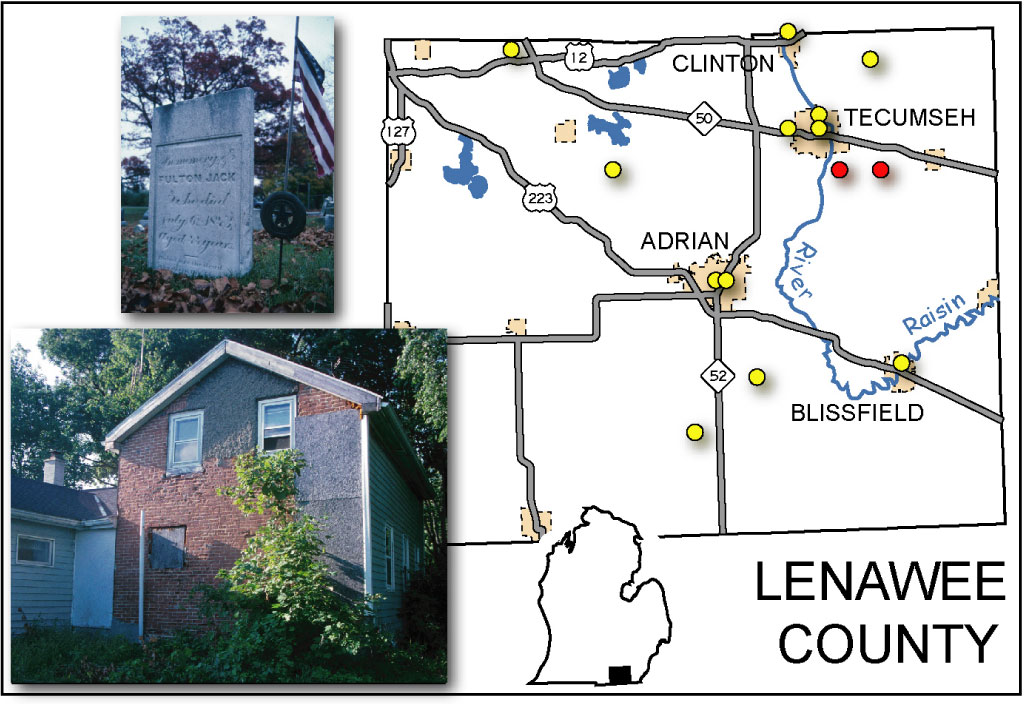
lenawee-shreder

The above is a slide from the very first Black Hawk talk I gave, almost 6 years ago. The brick house in the lower left was built by a man who served in the militia at the time of the Black Hawk war scare. Later in life, one of the most significant events of his life that he recalled for the local county history writer was that he had once seen George Washington. It had been at a distance, when he was a very small boy.

While I wished he had had more to say about what happened during the Black War, there was a good reason to attach such significance to George Washington. A Christmas article in the Wall Street Journal reminded us of it.

It’s titled, “Washington’s Gift,” and is written by Thomas Fleming. It looks like Mr. Fleming has written a new book about Washington that I need to be reading.

When I started on the article, I thought it was going to be another one about the Newburgh Conspiracy. Not that there is anything wrong with that. It’s a story that needs to be told often. It was an event that I had once rated as one of the most important of the preceding millenium. George Washington defused a coup d’état in the making and refused to have any part in such a thing himself.

But no, this article is not about the Newburgh Conspiracy. It turns out that that affair wasn’t quite the end of the matter. Even after that close call, Congress wasn’t acting any more responsibility. Some thought Washington might have a change of heart. But instead, he resigned his commission, just before Christmas. When King George III heard about it, he said that if it was true, George Washington was the greatest man in the world. Years later John Trumbell saw fit to capture the moment in a painting. And Thomas Jefferson saw the significance, too, when he wrote:

The moderation. . . . of a single character probably prevented this revolution from being closed, as most others have been, by a subversion of that liberty it was intended to establish.

That single character was of course George Washington, who was strong enough to resist the temptation to do what almost every other revolutionary leader has done.

I hope the brick house in Lenawee County is still standing and remains standing as a monument to George Washington and his act of self-abnegation.

Dec 222007
 

The Main Adversary has a couple of carefully nuanced articles about McCarthyism.  Most excellent.  I hadn’t been reading that blog regularly the last few busy weeks, and almost missed this stuff entirely.   I’m linking to the articles here, for myself if for noone else.  They have a bunch of links that I haven’t followed up on yet.

Washington Decoded

What was McCarthyism

Dec 212007
 

centreville-courthouse

This is the old courthouse in Centreville, Michigan, the seat of St. Joseph County. I often use this area, or the sandwich shop across the street, as a place to take a break on my rides through the county.

Kitty-corner across the street, to the northwest, is the location of the very first courthouse, so to speak. It was a multi-purpose building, and was the scene of the court where a judgment against Patrick Marantette had been appealed back in the early 1830s. On the order of territorial Governor George Porter, Marantette had destroyed the whiskey kegs of a farmer who had come on the nearby Nottawasepe reservation during treaty payment negotiations. The farmer had been trying to sell whiskey to the Indians, which was illegal for him to do at that time and place. The farmer then sued Marantette for the destruction of his property. The case dragged on for a few years before a final judgment was rendered against Marantette.

I’ve blogged about it in these two articles (here and here) over at The Spokesrider.

I think about it in connection with the dispute between George Bush and congress over whether telecom companies should be made immune to lawsuits over their actions in assisting the Bush administration with its wiretaps. My own choice of where to draw the line between legal and illegal wiretapping would probably be somewhere between the Bush’s ideas and those of his moonbat opponents.

Well, I don’t for one minute believe the leftwing moonbats are opposed to his wiretaps. What they’re opposed to is George Bush. They have some very good arguments on their side, but as we’ve seen in the past, they’ll throw them out once their own person is in the Oval Office.

Wherever the line is drawn, I don’t think we should be comfortable with the idea of giving the telecom companies a free pass. In a society that relies on checks and balances, not only between branches of government but among private institutions as well, we need the telecom companies to think long and hard before deciding that the government is asking them to do the right thing. They should not be allowed to switch their brains and moral compasses off just because they’re doing what the administration tells them to do.

We don’t allow soldiers to blindly follow orders to commit atrocities. Why should we allow the telecoms to do so?

What does this have to do with Marantette? Not that the outcome was just, but I had thought his case was an old example of where a private citizen was NOT given immunity for work he did against another citizen at the request of government. Well, the journal kept by the court tells us that a judgment of a little over a hundred dollars in damages and court costs was assessed against Marantette in the end. But just a couple of days ago I stumbled upon information in the archives showing that the U.S. Commissioner for Indian Affairs in Detroit had paid the $300 fee for the lawyer who defended the suit against Marantette.

Not that it argues one way or another in the case of George Bush’s wiretaps, but just the same I like knowing the historical precedents for things like this.

Dec 182007
 

Here’s a BBC article about “Russia’s deep suspicions of the west“.

The author, Rupert Wingfield Hayes, seemed to find that the Cyrillic highway signs made Russia unfriendly for foreign tourists. I’m not quite sure what he expects. If I ever got to do the bicycle tour in Russia that I’d like to do, I really wouldn’t care to have English language signs as a crutch. If I want to read highway signs in English, I can do that at home. I don’t need foreign travel for that.

He also makes some other points that make it sound like Russia still is as inward-looking as it was before the time of Peter the Great, or at least that it is turning back to those days. He talks about the hostility to foreign investment and the shutting down of the British Council centres in Russia.

I can’t say I like this hostility. Sometimes on weekend evenings I watch the standup comedians on RTR Planeta. I can understand hardly anything of what they’re saying, much less “get” the jokes, but one thing I do note is that an inordinate amount of time is spent making fun of America and Americans.

Russian comedy skits about Americans? Yes. When’s the last time you saw an American comedy skit making fun of the foibles of Russians?

And as far as Russia being inward-directed, it should be noted that an ubiquitous symbol is still the Foreign Ministry building in Moscow. You’ll see it on every Mosfilm DVD and you see it as a background on the news programs. Seems to me Russia has more than itself on its mind.

Dec 122007
 

I doubt I will vote for Mitt Romney. I don’t worry about his ties to the Mormons, but I do worry about his ties to his father.

I was reminded of his father when reading Jeffrey Lord’s article in The American Spectator, “What would Mitt do?” Lord points out that he’s one of those pragmatist types who claims he would be guided by data. In other words, he’s going to pander to whoever he can gain the most from by pandering.

I remember watching Romney on TV at the 1964 Republican convention. And I remember Goldwater’s speech in which he said, “Extremism in the defense of liberty is no vice. Moderation in the pursuit of justice is no virtue.” (I think I was one of the few people in the Central Time zone who was still awake to watch it.) I took it to be directed at the Romneys in the Republican party, as well as all the media types he was pandering to.

In looking this up to refresh my memory, I learned here that Romney had wanted Goldwater to use a different version: “”Extremism in defense of liberty is not a vice but I denounce political extremism, of the left or the right, based on duplicity, falsehood, fear, violence and threats when they endanger liberty.”

Note that Romney did NOT say he wanted Goldwater to say, “I denounce political moderation, of the left or right, based on duplicity, falsehood, fear, violence and threats when they endanger liberty.”

We don’t need a second coming of Romney any more than we needed a second coming of George Bush.

(Lord’s article also appears in today’s WSJ.)

Dec 072007
 

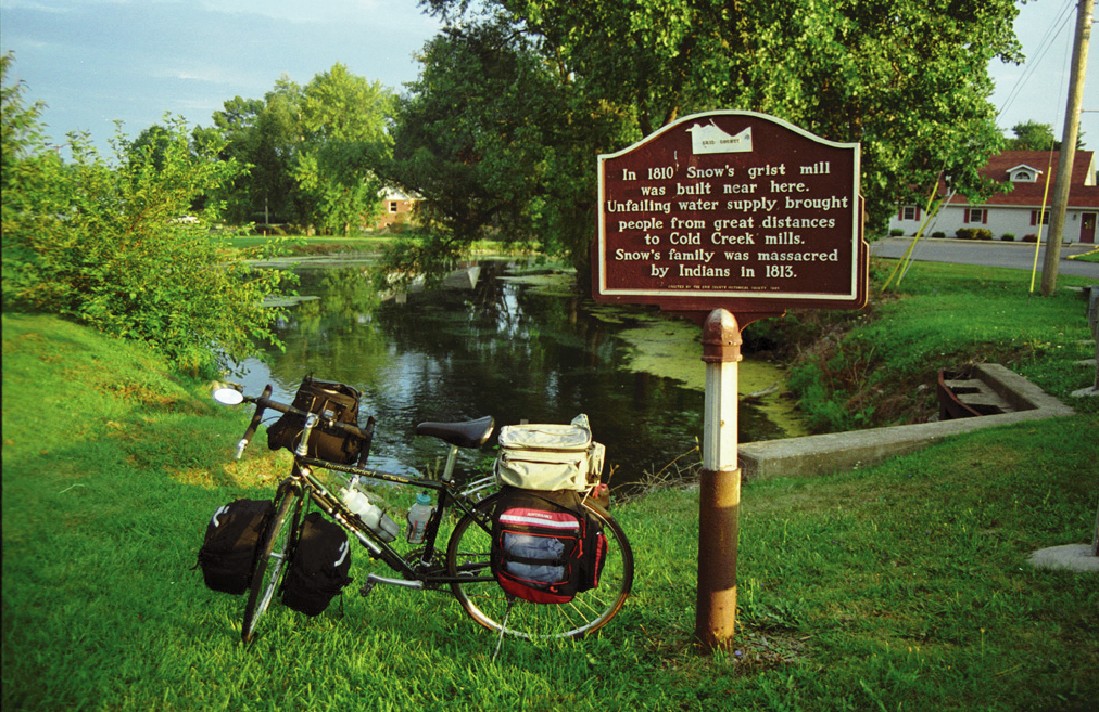
coldcreeksign

This photo belongs in my Spokesrider blog, but it belongs here, too. It was taken at the end of the most unusual segment of a 3-day Labor Day weekend bike tour back in 1998. There is a connection to that article that Eunice Yu and Jianguo Liu wrote about the “Environmental impacts of divorce.” (I’ll get around to explaining the bike tour part over at The Spokesrider.)

I’m going to get started here WITHOUT explaining just yet how that photo fits.

In their conclusions, Yu and Liu explain that their paper is about more than just divorce.

Divorce is just one mechanism that leads to a decline in household size and extra households. Other mechanisms include declines in multigenerational households, delays in first marriage, increases in empty-nesters, and increases in separated couples. These alternate lifestyles may create environmental impacts similar to divorce through a reduction in average household size and an increase in the number of households. As global human values continue to shift toward greater autonomy and choice, the environmental impacts of increasing divorce will continue unless effective policies to minimize household dissolution are implemented or divorced households are able to improve their resource-use efficiency.

That last sentence seems to be a call for greater government action of a kind that leftwingers might like (though the very next sentence gives an example of how government restrictions on divorce don’t necessarily work). But I would like to point out that maybe it’s too much government action that has caused some of this autonomy that degrades the environment in the first place.

Take SCHIP, for example. It’s far from the first instance where government has taken over the role of parents, making their role less important. When government plays daddy and mommy to kids and provides their health care, then the decision-making process that led to daddy and mommy getting married in the first place is not such a terrifyingly important one. They can marry for what seems like love, or excitement, without really asking themselves if the other person is a good one with whom to make a lifelong committment. If it doesn’t work out and it ends in divorce, well, the government will help pick up the pieces. SCHIP just carries this shift in the role of marriage and parenthood a little further.

And if the Yu/Liu connection is correct, things like SCHIP may be responsible for environmental degredation.

There are some counterarguments that I’m not going to go into just yet. Nor have I explained yet what that photo has to do with it. Later.