Reticulator

Sep 042007
 

I’ve been saying for several years that the greatest current threat to our civil liberties is nationalized health care.   John Edwards was recently kind enough to show how it works:

Edwards backs mandatory preventative care: 

It requires that everybody be covered. It requires that everybody get preventive care,” he told a crowd sitting in lawn chairs in front of the Cedar County Courthouse. “If you are going to be in the system, you can’t choose not to go to the doctor for 20 years. You have to go in and be checked and make sure that you are OK. …

Edwards said his mandatory health care plan would cover preventive, chronic and long-term health care. The plan would include mental health care as well as dental and vision coverage for all Americans.

Of course, this talk about preventative care is what also gave us HMOs, brought to us by the same people who are now pushing a single-payer HMO on a national scale.

And mental health care was a formidable weapon against political dissidents in the old Soviet empire.

Let’s have separation of Health Care and State for the very same reason we have separation of Church and State.
Sep 042007
 

Interesting closing paragraph to a WSJ article about the new Museum of the Soviet Occupation in Georgia:

The story goes that Vladimir Putin considered the display highly provocative and asked President Saakashvili why Georgia would do such a thing. After all, the most prominent butchers were themselves Georgian, such as Stalin and Beria. Mr. Saakashvili responded that the Russians were free to open a museum about how Georgia had oppressed them. The Georgian no doubt knew well that such an exhibition would offend his menacing northern neighbor with a former KGB officer at its helm, but he went ahead anyway. Perhaps he calculated that it was the best way to stop any of it from happening again.

Which reminds me, well over a year ago I used to see some interesting movies on RTR Planeta about the bad old days of Stalin and his executions. I seldom get to watch that station on the internet anymore, but sometimes I do. I wonder if Putin still allows that kind of thing to be shown any more.

Sep 022007
 

Quote from Peggy Noonan in the WSJ: “You’d better be pretty good going in, because it’s not going to make you better.”

She’s talking about politicians going into politics.

I’ve often said that politicians are generally less corrupt than their constituents. What often provokes me to say that is seeing what people ask their congresspersons to do for them — things that a congressperson would have no business doing in a good government.

Peggy Noonan is referring to something a little different — the way politicians both left and right need to change to deal with the Iraq war.

A time for grace

America needs unity in dealing with Iraq. That means the president must lead.

Friday, August 31, 2007 12:01 a.m. EDT

What will be needed this autumn is a new bipartisan forbearance, a kind of patriotic grace. This is a great deal to hope for. The president should ask for it, and show it.

Normally I’m against bipartisanship, but in this case I think Ms Noonan is right.

Aug 282007
 

The WSJ tells about controversy in Japan over new trash rules:

Talking Trash: Tokyo residents feud over controversial garbage rules

It’s about how Tokyo will run out of landfill space in 30 years. The city is trying to extend that time by changing the rules about what trash can be incinerated in the city incinerators. Rules are changing for residents about how they should sort their trash. For example, things such as styrofoam food containers were in the past supposed to go in the bags destined for the landfill; now residents are increasingly encouraged to put them in the bags to be incinerated.

The above headline misses the really interesting point though. Of course there is controversy over this. There are environmental issues, and there is the fact that old customs die hard. But what was interesting to me was the method of social control:

There are no fines to punish offenders. That’s because Tokyo can rely on neighbors’ ire to keep everyone in check. Sanitation workers can refuse to collect garbage that is improperly separated or taken out on the wrong day or left in the wrong place. This adds to the shame of the culprit, since neighbors will see that the bag wasn’t collected that day.

According to Ryouichi Sawachi, a 62-year-old maintenance man in charge of trash at a Tokyo apartment complex, a messy communal area sends a message that residents don’t obey the rules, which can lead to crime and property devaluation. “A person’s morality is really tested when it comes to disposal of trash,” Mr. Sawachi says.

Punishment takes various forms. When 27-year-old apparel maker Asami Sakurai moved to Tokyo from Yokohama in 2004, she didn’t know which days to take out her burnable and nonburnable trash. So a neighbor showed her, laying a bag full of banana peels, toilet-paper rolls and soggy rice cakes out neatly…on Ms. Sakurai’s front doorstep.

This is different. Traditionally people have left small towns and villages to go to the city to get away from the neighbors. Where it takes a village to raise a child, the adult children want to go someplace where they don’t have the whole village playing parent. So they go off to the city at the first opportunity.

But here, one of the most densely crowded cities in the world is a place where the neighbors are expected to mind each other’s business. Have the rules about village vs city always been different in Japan than in the west? Or is it more the case that when population density increases beyond a certain point, the city needs to become a village again?

Aug 212007
 

Chemists Find What Makes Coffee Bitter says this Yahoo article about a LiveScience article, never mind that I can’t seem to find the original at livescience.com.

“Roasting is the key factor driving bitter taste in coffee beans. So the stronger you roast the coffee, the more harsh it tends to get,” Hofmann said. He added that prolonged roasting leads to the formation of the most intense bitter compounds found in dark roasts.

Oh, yeah?  These people seem to be confusing harsh with bitter.ÂThey are not the same thing, at least not in coffee. I found an actual livescience article from two years ago that gets that part right:

Bitterness comes from skimping on grounds when you brew, brewing for too long, and brewing in a pot or machine with residual grounds left from hours, days or weeks ago.

The person who wrote that knew what he was talking about.  Those are exactly the factors that make coffee bitter.  And bitter is bad.
But harshness is something else entirely. Starbucks coffee tends to be harsh.   Their school of coffee-thought has been labeled the “Burnt is better” school.  Some people like that kind of harshness.   I don’t myself, but I can understand, sort of.

The yahoo article has it partly right.  You get harshness from roasting too much.  But that’s not the same as bitter.

I wonder if that research was done by a non-coffee drinker.  I say never trust a non-coffee drinker to make your coffee.  And maybe you shouldn’t let a non-coffee drinker do coffee-taste research, either.

Aug 202007
 

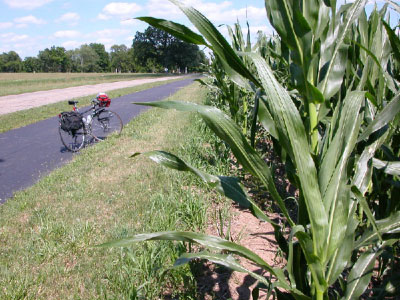
Bike path near Homer, Michigan

Is it true that bike paths like the one in this photo are responsible for bridges falling into the Mississippi River?

I encountered this one on a July 2005 bike ride to Homer, Michigan. I’ve been there since, and still haven’t seen any good reason for that particular bike path to exist. The money would have been better spent on the road alongside, which would have made conditions better for both cars and bicycles.

A Wall Street Journal editorial, “Of Bridges and Taxes,” tells how tax money for highways in Minnesota was spent on many things other than what taxpayers probably thought they were buying. One of these was bike paths.

I’m all for things we can do to encourage greater use of bicycles for transportation, but bike paths are not usually the way to do it. Sometimes bike paths do accomplish that purpose, but often the money spent on bike paths is a sop to interest groups, and NOT a way of fostering alternative means of transportation. Those paths are usually for recreation, not transportation. They don’t usually take me where I want to go. For that I need roads, often the same roads that cars use.

As for the falling bridges, the WSJ article contains this sentence of the day: “Minnesotans already pay twice as much in taxes per capita than residents in New Hampshire and Texas–states that haven’t had a major bridge collapse.”

Aug 162007
 

From Daniel Henninger at the WSJ:

…Now comes word that diversity as an ideology may be dead, or not worth saving. Robert Putnam, the Harvard don who in the controversial bestseller “Bowling Alone” announced the decline of communal-mindedness amid the rise of home-alone couch potatoes, has completed a mammoth study of the effects of ethnic diversity on communities. His researchers did 30,000 interviews in 41 U.S. communities. Short version: People in ethnically diverse settings don’t want to have much of anything to do with each other. “Social capital” erodes. Diversity has a downside….

Give me a break! you scream. What about New York City or L.A.? From the time of Sherwood Anderson’s “Winesburg, Ohio” through “Peyton Place” and beyond, people have fled the flat-lined, gossip-driven homogeneity of small American “communities” for the welcome anonymity of big-city apartment building–so long as your name wasn’t Kitty Genovese, the famous New York woman who bled to death crying for help….

The diversity ideologues deserve whatever ill tidings they get. They’re the ones who weren’t willing to persuade the public of diversity’s merits, preferring to turn “diversity” into a political and legal hammer to compel compliance. The conversions were forced conversions. As always, with politics comes pushback. And it never stops.

The harvest of bitter fruit from the diversity wars begun three decades ago across campuses, corporations and newsrooms has made the immigration debate significantly worse. Diversity’s advocates gave short shrift to assimilation, indeed arguing that assimilation into the American mainstream was oppressive and coercive. So they demoted assimilation and elevated “differences.” Then they took the nation to court. Little wonder the immigration debate is riven with distrust….

Like he said, there’s lots here to argue about. But I think I’ll want to find that original article and see if I can stand to read it.

Aug 122007
 

We’re just now finishing up breakfast at a campground. I was telling my wife how I dreamt last night that I introduced the new Associate Justice of the Supreme Court to the Clintons. He was someone I had met earlier in the dream, very young, and presumably conservative, though I can’t say who he resembled. My wife and I were sitting at a table in a church basement-like setting when the Clintons came over and sat down across from us. I think there was some conversation, though I’ve already forgotten that part of the dream. Then the young Judge came over to the table, and I figured the proper thing would be to introduce him to the Clintons. They were speechless at seeing this young Judge, and looked at each other, but Bill soon recovered and gave him some of his “You know, we have to work together, blah, blah, blah.”

I think the stimulus for this encounter was an old article of Peggy Noonan’s that Opinion Journal.com had mentioned a day or so ago:

“Peggy Noonan http://www.opinionjournal.com/columnists/pnoonan/?id=85000464 more or less predicted 9/11 (and Bill Clinton’s evasion of responsibility for it) in a Jan. 19, 2001, column, and we don’t remember being particularly perturbed as we edited it.”

The part of Noonan’s article that got me to thinking was this:

That the speech was lacking in grace or largeness goes without saying, that it offered seemingly wise and even avuncular words with a subtext of political aggression and competitiveness was in its way perfect. That is what Mr. Clinton’s career has been, aggression offered as sympathy.

I used to say similar things back in those days, but not in such fine words as Ms Noonan used.

It had been quite a few years since I met any presidential persons in my dreams, and this was the first for a Supreme Court Justice. And it’s nice sitting at the campground picnic table to use the internet, but the sun is coming up to make my screen hard to read, and it’s time to be off on a bike ride.

Aug 082007
 

It seems that a lot of folks are so full of hate for George Bush and hate for tax cuts that they’ve abandoned a lot of their values in the wake of the I35-W bridge collapse — just for a chance to do some Bush-bashing and tax-raising. For partisan political gain, they’re allying themselves with the forces of modern development that are turning the earth into a monotonous, bland place and which disconnect us from the environment and from each other.

I’ve blogged about bridges in my bicycle blog: Bridges to Planet Earth where I breathed a sigh of relief that an old bridge in Tennessee is not currently threatened by the safety-efficiency people.

Personal recollection: When we lived in St. Cloud, MN in the mid 70s it was on the opposite side of the Mississippi from the University where I was going to grad school. We lived close enough that I often walked across the bridge to get there — the 10th Street Bridge. It was a rickety old thing that rattled as cars went across, and it couldn’t handle the volume of traffic that some planners thought should be directed through our neighborhood.

In the winter time it was a COLD walk across that bridge. It could be quite a painful ordeal. The river runs north and south there, and the valley acts as a wind channel for the cold north winds. There was nothing on those trusses to shelter you. Brrr. It makes for quite the memories now.

I found somebody else’s blog entry about that bridge: Deep Blade Journal It has photos of the old bridge and of the new one that replaced it. Replacement was always a controversial topic while we lived there. Planners wanted to replace it; those of us who lived in the community didn’t want it replaced, and it was held off for many years. It couldn’t last forever, though, and eventually the safety-efficiency people had their way. There is now a new bridge, a lot of traffic, and the world is a more boring place for it. I’ve been back to drive across the new bridge a few times, always with a sense of loss.

But it’s not all loss. Not until I saw the above blog entry did I see the underside of that bridge. It’s not your ordinary boring Interstate bridge. The designers and engineers could have done a lot worse. Maybe someday people will be just as protective and fond of that one as we were of the old 10th Street bridge.

Main point, though: There’s more to life than safety and efficiency.