
My, oh my. Google News is sure beating the drums hard on this SCHIP thing. They have made this the top story for I don’t know how long, using the most propagandistic headlines they can find.

My, oh my. Google News is sure beating the drums hard on this SCHIP thing. They have made this the top story for I don’t know how long, using the most propagandistic headlines they can find.
The judge made a reasonable decision, I suppose, but what business do judges have in making such decisions in the first place? These are judgment calls that could reasonably be decided a number of different ways. Wouldn’t it be better for local school officials to be making them? And what would be so terrible about them not all making the same decision? Why do all the schools have to march in lock-step? So long as local principals and teachers have to watch their backs for fear of what local taxpayers and parents say, that would seem to be sufficient control, and one more robust in surviving occasional mistakes.
It’s bad enough in the United States where state boards of education make decisions for the schools in the state. That was one of the bad things about John Engler’s school finance reform in Michigan — it took a measure of control out of parents and local taxpayers’ hands, and turned it over to a state educational bureaucracy. Whatever the fiscal merits, they can hardly have been worth that cost.
Here‘s what the fuss is about:
Schools will have to issue a warning before they show pupils Al Gore’s controversial film about global warming, a judge indicated yesterday.
The move follows a High Court action by a father who accused the Government of ‘brainwashing’ children with propaganda by showing it in the classroom.
Stewart Dimmock said the former U.S. Vice-President’s documentary, An Inconvenient Truth, is unfit for schools because it is politically biased and contains serious scientific inaccuracies and ‘sentimental mush’.
He wants the video banned after it was distributed with four other short films to 3,500 schools in February.
Mr Justice Burton is due to deliver a ruling on the case next week, but yesterday he said he would be saying that Gore’s Oscar-winning film does promote ‘partisan political views’.
This means that teachers will have to warn pupils that there are other opinions on global warming and they should not necessarily accept the views of the film.
He said: ‘The result is I will be declaring that, with the guidance as now amended, it will not be unlawful for the film to be shown.’
“Obama argued that U.S. policy is still focused on the defunct Soviet Union instead of combatting the nuclear threat from rogue nations and terrorists.” AP
Huh? Still focused on the Soviet Union? With all the noise the Bush warmongers are making about Iran?
Isn’t Barack Obama a little young to be this out of date and out of touch? Where has he been the past couple of decades?
And where are the reporters who should have challenged that statement?
It was disorienting when I happened across this article a few weeks ago by Justin Fox in Time mag. (I wouldn’t want Time in our house; it was something I saw while making a cup of coffee in the lunchroom at work.)
Talking about the sub-prime loan crisis, he says:
Does this mean we need more regulation? Maybe, maybe not. It does indicate, though, that the mortgage business might be due for a return to its roots.
The disorienting part was that he seems to care what kind of regulation might be needed. Usually you have lefties crying for more regulation, and righties wanting less. It’s frustrating, because what usually matters is the kind of regulation.
Do people want regulation that creates new bureaucracy with the power to play favorites? Do they want regulation that uses market forces to the maximum extent possible? We hardly ever get into those discussions.
That’s not exactly what Fox wants to talk about, but he does seem to keep his head about him. And I think he makes a plausible point about the need to “shift mortgage risk back into the banking industry.” Maybe I’m prejudiced, because I think that too often the God of Almighty Liquidity creates situations where people-to-people interactions vanish, which is what happens when banks freely sell off loans to other companies that have had no relationship with the borrower.
I had seen a few references to Hillary Clinton’s laugh/cackle, but I regret to admit that I wasn’t paying enough attention to join in the Hillary-Bashing. It’s not like me to miss out on an opportunity.
But I see from Dick Morris’s Column that there was more to it than the laugh.
But every once in a while, there’s a rare moment of clarity. That happened last year when Wallace interviewed the former president. At the end of the interview, Bill lost it. Suddenly the veneer was off, exposing the enraged, snarling, lunging Bill accusing Wallace of “do[ing] his nice little right wing hit job” when he forced Clinton to address his inability to capture or kill bin Laden.
Not a pretty sight.
And Wallace did it again in his recent interview of Hillary. Asked about the extreme partisan politics espoused by her and her husband, the real Hillary challenged Wallace. “Well, Chris, if you’d walked even a day in our shoes over the last 15 years I’m sure you’d understand.”
Oh, yeah? And what is that supposed to mean? Lots of people on all sides of political issues have come in for heavy criticism and opposition. Is she saying criticism of the Clintons is what explains her extreme partisanship? If so, how come it’s only the Clintons who have that kind of reaction to it?
Well, at least she didn’t deny that she was an extreme partisan.
(I don’t think this comment was as revealing of the real Hillary as the one in 1993, “I can’t be responsible for every undercapitalized business.”)

I wish I knew
why the black walnut trees in our yard still have lots of leaves, even though it’s October already! The ones lining the county road less than half a mile away away lost their leaves long ago, as self-respecting Juglans nigra should. The photo above is of some that had mostly lost their leaves by September 20, which is still a bit late in the year to have as many as are shown. But those in our yard still have lots more than that.
A Percent for Art? How come governments are now treating artists (narrowly defined) as a privileged aristocracy?
From the WSJ:
When Yahoo moved into its Sunnyvale, Calif., headquarters six years ago, it kept peace with local authorities by buying and installing $500,000 worth of public artworks.
Now Yahoo says it is suffering for its art.
On its front lawn, the technology giant installed a work by New York artist Sharon Louden that paired real wetlands grass with artificial cattail-like reeds. The grass grew. The city complained. Last year, to rein in its overgrown yard, Yahoo dispatched a grounds crew with weed whackers.
Artificial reeds were cut, bent and twisted. The artist, horrified, responded with letters from her lawyers, which were met with letters from Yahoo’s lawyers. “They turned my art into a bad miniature golf course,” Ms. Louden says.
As negotiations continue over who controls Yahoo’s front yard, the company has found itself caught at the intersection of two artist-friendly laws — one that made the company install art, and a second that essentially prohibits the company from messing with it.
Like Sunnyvale, many cities across the U.S. have embraced the “Percent for Art” movement. Typically, cities ask or require companies to allocate 1% of their construction budget to buying and prominently displaying art, often in exchange for tax cuts or use of public land.
If Yahoo wants to be foolish with its money, that’s it’s own business. But is it proper for governments to be skimming money off of projects to divert to some of their favorites?
But it’s more than just a matter of fiscal responsibility and fairness. Consider this quote:
The governors of men have always made use of painting and sculpture in order to inspire in their subjects the religious or political sentiments they desire them to hold. –Diderot
I’ll bet that holds true for lawn sculpture as well.
I’ve long advocated Separation of Arts and State for the same reason that we have Separation of Church and State.
When I first saw this Yahoo news article, I figured there had to be more to the story:
A Spencer, N.Y., student was sent home from school last week for wearing a T-shirt that denounces homophobia.
Heathyre Farnham, 16, said she was not trying to be inflammatory by wearing the shirt that says, “Gay? Fine By Me.”
Contrary to what the lead sentence says, there’s nothing in that message about homophobia. (What would have been really interesting would have been a T-shirt that said, “Gay? Fine By Me. Homophobic? Fine By Me.”)
It turns out there are news articles with additional information, though it seems most of the information comes from one side of the conflict. The school doesn’t want to talk to the news media about it, which I suppose is reasonable. These types of stories can get spun one way or another so easily, as any parent or teacher who has had to referee a squabble can tell you.
But it’s interesting that all of a sudden, out of the blue, religion is dragged into it. Here it is, a non sequitur from another version:
Beeman [the kid’s mother] noted that religious issues had proven disruptive the previous school year, with students saying that their lessons at school contradicted their religious training.
Said Beeman, “There’re six churches in the area,” and added that the locale “tends to revolve around this religious hub.”
Added Beeman, “It tends to infiltrate into the school. Last year classes would be interrupted by period-long debates, that ’they shouldn’t be teaching this.’”
Said Beeman, “We’re very tolerant of people’s beliefs, but we don’t want them shoved down our throats and that tends to be what happens.”
Note the word “infiltrate.” It took me a while to realize why that bothered me. But now I remember. Back in the 50s, it was a word often used by people complaining about communists “infiltrating” schools and Hollywood. I know the folks using that word back then meant it was a bad thing. Sounds like this Beeman thinks it’s a bad thing, too.
Others might thing think it healthy that people with diverse beliefs can have their say and debate issues.
Here’s what one academic had to say about the subject of debates in the classroom. It’s something that’s posted in the library in the department where I work. You can find it in various places on the web, too.
It is important that students bring a certain ragamuffin, barefoot irreverence to their studies; they are not here to worship what is known, but to question it. — Jacob Bronowski
Sounds like that’s what’s happening at that school, in more ways than one. It’s too bad the news reporters didn’t do a little more questioning of their own, though, such as asking Beeman how she defines “shoved down our throats.”

This photo is dredged up from what once was a web site of mine, circa 1995. I got it to go with an article in the Weekend Edition of the WSJ, titled “Inconvenient Youths.” Here are samples:
In households across the country, kids are going after their parents for environmental offenses, from using plastic cups to serving non-grass-fed beef at the dinner table. Many of these kids are getting more explicit messages about becoming eco-warriors at school and from popular books and movies.
and
Some parents object to what they see as proselytizing by their kids’ schools. Mark D. Hill, who until recently was chairman of the Republican party in Marin County, says some mothers called him upset when their children came home from Bacich Elementary School in Kentfield, Calif., with fliers stuffed in their backpacks advertising a screening of “An Inconvenient Truth.” The parents thought the public school shouldn’t promote the screening, which was paid for by a local parent, because they considered it a political statement.
Sally Peck, the principal of Bacich, disagrees. “We have a responsibility to educate our children,” she says.
Mr. Hill says the mothers worried their children would be criticized if they spoke out, so they kept their names secret. “It’s very scary for mothers,” he says. “They kind of go with the programs because they don’t want to be viewed as trouble-makers.”
It would seem that Principal Sally Peck is having trouble distinguishing indoctrination from education. These people think it’s OK to indoctrinate kids in environmental morality, but watch what happens when you suggest that kids be taught sexual morality.
But it can’t be helped. Some sort of morality is going to be taught.
Here’s an idea, and this is where the photo comes in. The photo is of the old District No. 3 schoolyard in Bazile Mills, Nebraska. It was taken a couple of hours before my first bike tour ever, in summer 1995. The school was long gone, but I’m showing my youngest son where we used to play softball. When I was a kid we lived in a house to the right of the church in the photo, where my father was pastor. We usually walked to school across that field.
It was a two-room public school, and when the school consolidation movement came to Nebraska in the 1950s there was a big battle over whether the school should be closed and consolidated with the Creighton school, three miles away. My parents were on the anti-consolidation side. They were so unhappy with the high-handed techniques that had been used in an attempt to close the school that when it came time for me to go to high school, they didn’t send me to Creighton. They instead sent me to a smaller school to the north at Center, on the edge of the Santee Sioux reservation. I was fortunate to have had that experience — both the school experience and the witnessing of what my parents did to try to preserve quality of education.
What does that have to do with our little eco-warriors? Well, if teachers really want to teach about cutting down on greenhouse gases, they will want to teach the kids that the school districts should be broken up into small neighborhood schools — us-consolidated, if you will, so that not so much fuel will need to be burned transporting kids to school and school activities.
One photo I didn’t find was of the area at the base of the Gull Creek valley in Kalamazoo County, MI. That used to be the prettiest little valley in Kalamazoo County. It reminded me of Ireland somewhat. But when the community of Galesburg decided to build a new school, they did the same as so many others and built it out in the country where there was room for massive parking lots for all the kids who drive to school. It destroyed the lower end of that little valley. And who can blame kids for driving, or parents for driving their young ones, when the alternative is that abomination known as the school bus Whether children travel by bus or by car, if schools were unconsolidated it would make a huge difference in greenhouse gas emissions.
But no, just the opposite is being done. Our Gull Lake school district recently closed a fine little elementary school in Bedford — the one my youngest son attended. Now kids have to be transported a much greater distance to a centralized school. Given that research has shown that smaller community schools usually provide better education, the school district isn’t going to have much credibility the next time it appeals for more money.
Of course, teachers and administrators are -not- going to advocate decentralization. Doing so would give parents a greater say in their children’s education, which is anathema to the modern educational establishment. Environmental issues are OK up to a point, and that is one of those points.
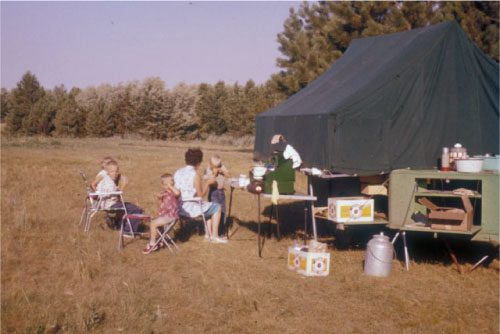
This photo is one of my father’s 35mm slides from 1959. It was deteriorating badly, but I did what I could with it, along with a bunch of others I did for my parents’ 60th wedding anniversary this summer.
So what does it have to do with George Bush and SCHIP? Well, now that the Senate has passed the expansion of SCHIP, the script calls for George Bush to let some of his followers go out on a limb and support his threatened veto, then cut them down and stab them in the back by signing it anyway. Then conservative commentators will be bewildered as to why George Bush would have done such a thing, given that he’s done the same thing every time he’s had an opportunity to do so up to now.
That still doesn’t explain the photo.
I put it here because the problem with SCHIP is not so much that it will be an expensive boondoggle (though it will be that) as that it helps destroy families.
We didn’t have much money when I was growing up, but my parents managed to save enough so we could have one good travel vacation every summer. Dad built the travel trailer shown in the photo, and for a few years had to explain what it was every time we stopped at a gas station. Later pop-up campers became common. This one may look clunky, but you ought to have seen the one we borrowed for a trip to California in 1956. Dad improved on the design, substituting aluminum framework for the steel bedposts used as a tent frame on that one, and using thinner plywood.
In 1959 (the year of this photo) we went to the Canadian Rockies. I remember that Nikita Khruschev’s upcoming visit was in the news, and the idea of it was about as controversial as the recent one by Mahmoud Ahmadinejad. I remember Dad getting into a conversation with someone in Canada, saying maybe it was good that Khruschev would come for talks. It surprised me somewhat to hear him say that. (Now that I think about it some more, I remember it better. Dad did not say that. It was a topic of conversation at more than one campsite, and someone else said it. )
We managed to have money for a vacation every year, but to do that we had to do without other things. For example, I have crooked teeth because my parents couldn’t afford to get them straightened. I’ve always been grateful that they chose to take us on travel vacations instead. There are lots of good memories from those trips.
When I mentioned this a few years ago to my sister (who is in the photo, as am I) she said no parent should have to make such choices. I retorted that who could better make that choice than the parents? Do we want governments making those choices for us?
Resources are limited, and such choices will be made at one place or another.
But the real problem is that if you take away all of those terrifying decisions that parents have to make for their children, they cease to be parents and the children cease to be their children. The family community is replaced by an extreme individualism in which each individual’s relationship is more with the state, and less with the family. And that results in social pathologies such as we see in Great Britain, which is now carelessly throwing away its hard-won advances in human rights in order to deal with it. (Anti-social behaviour orders, anyone?)
Would our government really be breaking up families on purpose in order to replace family relationships with others more to its liking? Of course it would. It wouldn’t be the first time. Listen to James Monroe’s state of the union address in 1818:
Experience has clearly demonstrated that independent savage communities can not long exist within the limits of a civilized population. The progress of the latter has almost invariably terminated in the extinction of the former, especially of the tribes belonging to our portion of this hemisphere, among whom loftiness of sentiment and gallantry in action have been conspicuous. To civilize them, and even to prevent their extinction, it seems to be indispensable that their independence as communities should cease, and that the control of the United States over them should be complete and undisputed. The hunter state will then be more easily abandoned, and recourse will be had to the acquisition and culture of land and to other pursuits tending to dissolve the ties which connect them together as a savage community and to give a new character to every individual. I present this subject to the consideration of Congress on the presumption that it may be found expedient and practicable to adopt some benevolent provisions, having these objects in view, relative to the tribes within our settlements.
He says he wants to break up the community relationships of the Indians so they can be more easily controlled by the government. That’s what was done then, and that’s what’s happening now with things like SCHIP.
There! Not only did I tie together George Bush, SCHIP, and our family vacations from the 50s, but I tossed in a bonus connection to James Monroe and the conquest of the Native Americans, not to mention Nikita Khruschev and Mahmoud Ahmadinejad. It’s not for nothing that I’m called The Reticulator. (Other people tend to use slightly different language for it, though.)